If you are searching for what it costs to move a car 200 or 300 miles across the UK, the honest answer is that there is no single rate. The price depends on several factors working together, and the best way to know your figure is a fixed-price quote. This guide explains what actually drives the cost so you know what you are paying for.
Why there is no simple “per-mile” rate
It is tempting to assume a car costs a set amount per mile, but real logistics does not work that way. A 200-mile job on a busy corridor can be priced very differently from a 200-mile job to a remote area where the driver returns empty.
At MDM, established in 1990 with over 35 years of experience, we quote one fixed price for the movement rather than a running per-mile meter. You know the cost before you commit, with no surprises on arrival.
The factors that set the price
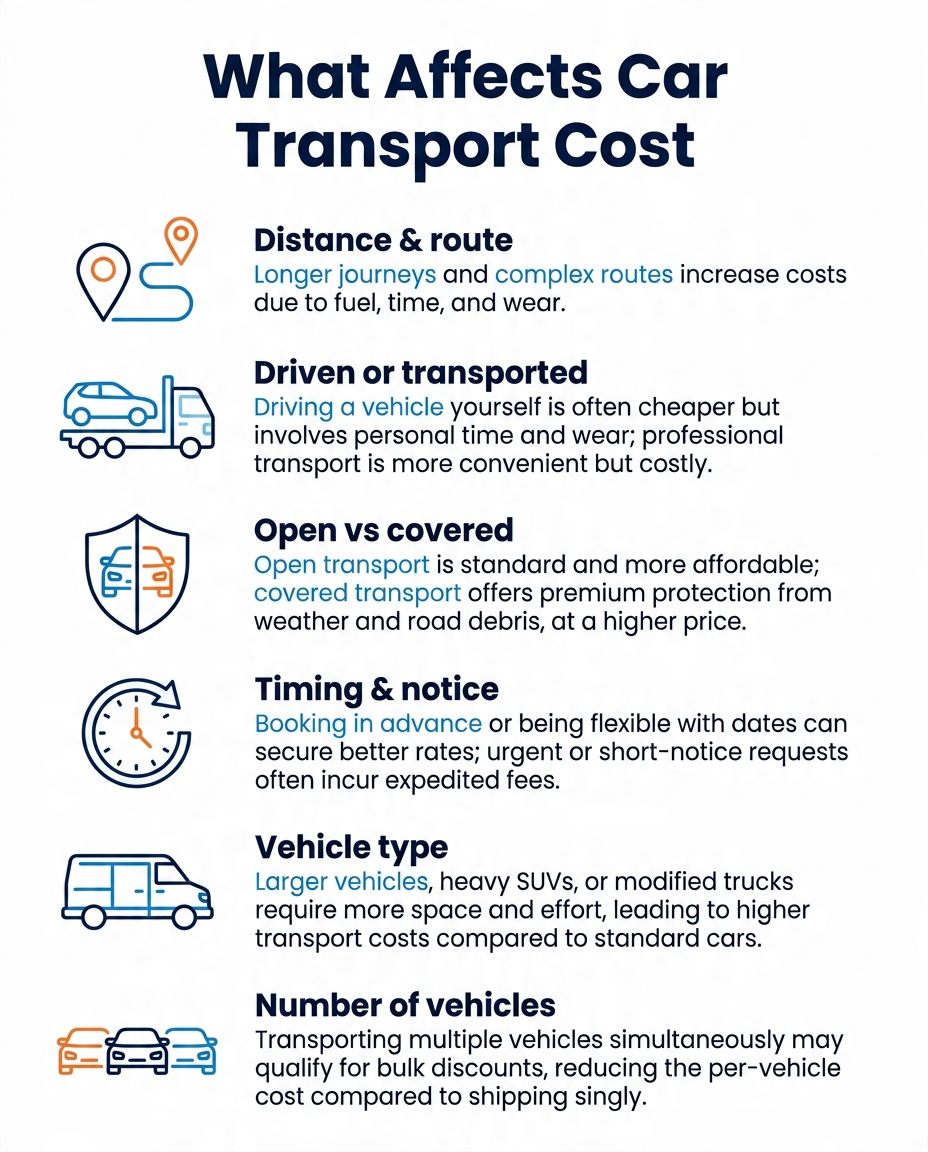
Distance and route
Total distance matters, but so does the route and return leg. If we already have work near your delivery point, we can often plan the movement more efficiently. Collections and deliveries that sit close to the motorway network are usually simpler than those down long rural approaches.
Our base at Woodview Farm in Stapleton, Leicestershire, sits centrally in the UK and on the motorway network, which helps us plan routes across England, Scotland and Wales efficiently.
Driven or transported
How the vehicle travels is one of the biggest factors.
- Driven by a professional trade-plate driver is often the most cost-effective option for a roadworthy car. The vehicle is driven under trade plates, with tax covered on the job.
- Transported on a transporter is used when a car cannot or should not be driven. It removes road miles from the odometer and suits non-runners and higher-value vehicles.
To be driven, a vehicle must be roadworthy with a current MOT. If it is not, it is transported instead.
Open or covered transport
Standard open transport is the everyday choice for most cars. Covered or enclosed transport adds protection from weather and road debris and is the natural choice for prestige, performance and classic vehicles. The extra protection typically carries a higher cost.
Timing and notice
How much notice you give affects planning. A movement booked with reasonable lead time can usually be slotted into an efficient route, while urgent or tightly fixed-date jobs are harder to combine with other work and may cost more.
Vehicle type and condition
A standard hatchback, a large SUV, a low-clearance supercar and a non-running project car all present different handling needs. Low-clearance and high-value vehicles may need specific equipment or enclosed transport. A non-runner needs winching rather than driving onto a transporter.
Number of vehicles
Moving several vehicles together, such as a dealer batch or a fleet, is usually more efficient per vehicle than a single one-off movement. If you have multiple cars going a similar way, tell us, it often improves the price.
What is always included
Whatever the method, every movement with MDM includes:
- Full insurance on the vehicle in transit
- Tax covered on driven jobs
- A photo condition report at both collection and delivery
- Instant proof of delivery
This means the price you are quoted covers a complete, documented service, not just the transport itself.
How to get an accurate figure
Because the factors above combine differently for every job, an online ballpark can be misleading. The most reliable approach is to tell us the collection and delivery postcodes, the vehicle, whether it runs, and your timing. We then give you a single fixed price.
For more detail on what shapes the cost, see our car transport cost guide.
When you are ready for your figure, request a fixed-price quote at /quote, call us on 01455 632830, or email transport@mdmvehicles.co.uk. We will give you a clear price with everything included.